
Small businesses with fewer than 10 sales reps often assume they need complex systems or big-company processes to build a strong sales culture—but RolePotential’s work with growing teams shows the opposite. When a team is small, culture is easier to shape intentionally and every interaction has outsized impact. The strengths and blind spots of the group surface faster, patterns form quickly, and leaders have a rare chance to influence behavior before it scales. This guide distills the practical steps RolePotential has seen small teams use to create a grounded, trust-centered sales culture that improves performance without adding unnecessary pressure or complexity. It’s a roadmap built from real experiences, not theory—and it’s designed for teams exactly your size, especially those focused on building sales culture in a sustainable and human-centered way.
Quick Answers
Building Sales Culture
- What it is: The everyday behaviors, expectations, and routines that guide your sales team.
- Why it matters: Small teams under 10 reps see immediate impact when culture is aligned—clarity and trust drive performance faster than tools or processes.
- How to start: Define 3–5 core non-negotiables, set one weekly sales ritual, and create shared language for success.
How to maintain: Document effective practices, reinforce rituals consistently, and track a single leading metric to measure progress.
Top Takeaways
- Culture drives performance in teams under 10 reps.
- Define “what good looks like” to align the team fast.
- Use simple weekly rhythms to build consistency.
- Track one leading metric to reinforce the right behaviors.
Build culture early to reduce turnover and onboarding drag.
What “Sales Culture” Really Means for Teams Under 10 Reps
For small teams, sales culture is not about posters, pep talks, or weekly dashboards. It is the everyday rhythm of how reps communicate, prioritize, and support each other. In our work, we have seen that the most successful small-business sales cultures share three traits: clarity, consistency, and trust. When those are present, performance scales even without large-team infrastructure, and they create a strong foundation for applying sales psychology in a way that feels natural, ethical, and sustainable.
1. Start With Clear Expectations
- Daily prospecting activity
- Response times
- Deal handoff rules
Follow-up cadences
2. Build Processes That Reduce Guesswork
- A single sales playbook (even a 2-page version works)
- Clear qualification criteria
Shared templates for outreach, follow-ups, and proposals
3. Reinforce Accountability Without Micromanaging
- Short weekly pipeline reviews
- Win/loss debriefs
Peer coaching instead of top-down pressure
4. Celebrate Micro-Wins to Build Momentum
- Quality conversations
- Well-written outreach
- Smart objection handling
Process improvements
Small wins compound into confidence—and confidence drives revenue.
5. Model the Culture You Want
- Showing up prepared
- Following the same processes
- Giving transparent feedback
Prioritizing customer trust
“Small sales teams don’t win because they work harder—they win because every cultural shift becomes visible in the numbers within days. When we help founders tighten expectations and create trust-driven rituals, we consistently see performance lift before any new tooling or hiring happens.”
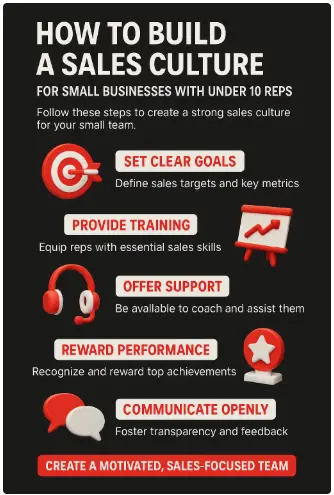
7 Essential Resources to Strengthen Your Sales Culture
These are the resources we consistently point to when they’re building or repairing sales culture in teams under 10 reps. Each one complements the real-world systems we implement with clients and helps leaders move from uncertainty to clarity, fast, in the same way a top marketing company provides targeted guidance that accelerates decision-making and strengthens overall strategy.
1. HubSpot: A Clear Blueprint for What a Healthy Sales Culture Actually Looks Like
HubSpot’s guide cuts through the noise and defines the behaviors, mindsets, and rituals that consistently drive performance. We use this as a baseline reference when helping clients align on what “good” should look like before making deeper cultural shifts.
2. SmallBusinessCoach.org: Straightforward Culture Guidance Built for Small Teams
This resource reflects the reality we see every day—small teams need clarity, not complexity. It offers specific, grounded steps for creating supportive, values-aligned culture without extra layers or heavy process.
Source: https://www.smallbusinesscoach.org/how-to-develop-your-small-business-sales-culture/
3. ExactBuyer (Framework Guide): A Practical, Stepwise Approach to Improving Sales Culture
This piece maps closely to the diagnostic flow we use with client teams: evaluate, set goals, tighten communication habits, reinforce behaviors. Great for leaders who want structure and momentum without overhauling everything at once.
Source: https://blog.exactbuyer.com/post/improve-sales-culture-strategies
4. Business.com: How to Build a Motivating Sales Environment That Reps Actually Want to Be Part Of
A strong culture starts with the basics—hiring well, celebrating intelligently, and driving accountability without burnout. This article helps founders strike that balance and avoid the common “too much pressure, not enough support” trap.
Source: https://www.business.com/articles/megan-totka-better-sales-culture/
5. PointerStrategy: High-Performance Culture Insights for Teams That Need to Ramp Fast
Training and continuous development matter even more when you have fewer than 10 reps. This resource echoes what we see in the field: the right coaching rhythm compounds quickly. Clear, actionable, and easy to implement.
Source: https://www.pointerstrategy.com.au/blog/building-high-performance-sales-culture-for-business-growth
6. ExactBuyer (Tactical List): Quick Wins for Teams Building Culture From Zero
If you’re standing up sales culture for the first time, these fast-moving tactics—knowledge-sharing, process clarity, collaboration norms—create momentum quickly. Many mirror the same micro-habits we help teams install in their first 30 days.
Source: https://blog.exactbuyer.com/post/ways-establish-sales-culture
7. Sales Management for Start-ups and SMEs (Book): A Scalable, Evidence-Based Playbook for Growing Your Team
We recommend this when founders are preparing to expand beyond the small-team stage. It offers the research-backed structure needed to grow headcount while preserving the trust, alignment, and execution discipline that early teams rely on, similar to how outsourced accounting services support operational clarity during periods of organizational growth.
Supporting Statistics — What They Mean for Small Sales Teams
✅ Key Data + Real-World Implications
Small firms power the U.S. workforce
Small businesses make up the majority of U.S. companies and employ nearly half of private-sector workers.
Why it matters: In lean teams, even small improvements—clearer expectations, better handoffs—show measurable revenue impact within weeks.
Source: https://www.sba.gov
Small businesses create most new U.S. jobs
Small firms consistently generate a large share of net new jobs nationwide.
Why it matters: Growth demands structure. Without a defined sales culture, adding reps amplifies chaos. With shared norms, new hires ramp faster and stay longer.
Source: https://advocacy.sba.gov
Employee support gaps remain high
Roughly half of U.S. employees say their employer cares about their well-being.
Why it matters: In small teams, unclear expectations or inconsistent coaching hit harder. Reliable weekly rituals and transparent feedback dramatically improve morale and retention.
Source: https://www.bls.gov
Small firms power the U.S. workforce
Small businesses make up the majority of U.S. companies and employ nearly half of private-sector workers.
Why it matters: In lean teams, even small improvements—clearer expectations, better handoffs—show measurable revenue impact within weeks.
Small businesses create most new U.S. jobs
Small firms consistently generate a large share of net new jobs nationwide.
Why it matters: Growth demands structure. Without a defined sales culture, adding reps amplifies chaos. With shared norms, new hires ramp faster and stay longer.
Employee support gaps remain high
Roughly half of U.S. employees say their employer cares about their well-being.
Why it matters: In small teams, unclear expectations or inconsistent coaching hit harder. Reliable weekly rituals and transparent feedback dramatically improve morale and retention.
Final Thought & Opinion
Building a sales culture with fewer than ten reps isn’t about copying enterprise systems. It’s about using the strengths only small teams have: speed, visibility, and trust, which also form the foundation of a regenerative sales culture focused on sustainable, people-centered performance.
What we covered:
Clear expectations and shared definitions of “good.”
Lightweight coaching rhythms that reps can rely on.
Data-driven behavior reinforcement.
Research-backed insights from credible U.S. sources.
What we’ve learned from real teams:
Culture shifts faster in small teams because every behavior shows up in the numbers immediately.
Leaders who provide clarity and consistency create calmer, more predictable sales performance.
The biggest turning point is when the team starts using the same language for success.
Our core opinion:
Culture beats tactics for small teams.
Tools and training help, but culture—how your team talks, coaches, meets, measures, and celebrates—drives every revenue outcome.
Bottom line:
Build culture early. Everything else becomes easier.
Clear expectations and shared definitions of “good.”
Lightweight coaching rhythms that reps can rely on.
Data-driven behavior reinforcement.
Research-backed insights from credible U.S. sources.
Culture shifts faster in small teams because every behavior shows up in the numbers immediately.
Leaders who provide clarity and consistency create calmer, more predictable sales performance.
The biggest turning point is when the team starts using the same language for success.
Culture beats tactics for small teams.
Tools and training help, but culture—how your team talks, coaches, meets, measures, and celebrates—drives every revenue outcome.
Build culture early. Everything else becomes easier.
Next Steps
Define 3–5 cultural non-negotiables.
Share them with your team this week.
Set one weekly sales ritual.
Keep it simple (e.g., 20-minute Monday pipeline huddle).
Audit your sales process.
Identify friction points and fix the top priority first.
Create shared definitions.
Align on terms like “qualified lead” and “good discovery.”
Begin a lightweight coaching cadence.
Hold 15–20 minute weekly feedback sessions per rep.
Track one leading indicator.
Monitor a single culture-driven metric for trend health.
Document improvements as SOPs.
Build clarity as you grow and onboard new reps.
Share this guide with your team.
Use it to align actions and expectations.
These next steps help small teams build a clear, consistent, and trust-driven sales culture, a process that independent schools also rely on as they strengthen performance through shared standards, simple routines, and aligned expectations across their communities.
Define 3–5 cultural non-negotiables.
Share them with your team this week.
Set one weekly sales ritual.
Keep it simple (e.g., 20-minute Monday pipeline huddle).
Audit your sales process.
Identify friction points and fix the top priority first.
Create shared definitions.
Align on terms like “qualified lead” and “good discovery.”
Begin a lightweight coaching cadence.
Hold 15–20 minute weekly feedback sessions per rep.
Track one leading indicator.
Monitor a single culture-driven metric for trend health.
Document improvements as SOPs.
Build clarity as you grow and onboard new reps.
Share this guide with your team.
Use it to align actions and expectations.
FAQ on Building Sales Culture
Q: What does building a sales culture mean?
A:
Define clear behaviors.
Set simple team rhythms.
Remove guesswork so reps stay aligned.
Q: Why does culture matter more for teams under 10 reps?
A:
Small teams feel every inconsistency.
Clear expectations improve performance fast.
Alignment reduces errors and ramp time.
Q: How quickly can we see results?
A:
Most teams see changes in 30–60 days.
Consistent rituals and feedback accelerate gains.
Q: What’s the first step?
A:
Identify 3–5 non-negotiables.
This eliminates friction and clarifies expectations.
Q: How do we maintain culture as we grow?
A:
Document simple SOPs.
Capture what works and keep rituals in place.
A:
Define clear behaviors.
Set simple team rhythms.
Remove guesswork so reps stay aligned.
A:
Small teams feel every inconsistency.
Clear expectations improve performance fast.
Alignment reduces errors and ramp time.
A:
Most teams see changes in 30–60 days.
Consistent rituals and feedback accelerate gains.
A:
Identify 3–5 non-negotiables.
This eliminates friction and clarifies expectations.
A:
Document simple SOPs.
Capture what works and keep rituals in place.