
Based on our hands-on experience analyzing cognitive skill development, this guide breaks the difference down in practical, real-world terms—from navigation and sports to learning and problem-solving. You’ll walk away with a clearer mental model of how these skills actually function, why they matter, and how understanding the distinction leads to better outcomes in everyday life.
Quick Answers
What is spatial recognition?
Spatial recognition is the mental ability to identify, remember, and visualize objects and patterns in space. It affects how you read maps, solve visual problems, organize environments, and understand spatial relationships—often before movement or physical action is involved.
From a practical standpoint, spatial recognition improves fastest when it’s trained intentionally through visualization, pattern recognition, and mental rotation tasks rather than general coordination exercises. From a practical standpoint, spatial recognition improves fastest when it’s trained intentionally through visualization, pattern recognition, and mental rotation tasks rather than general coordination exercises.
Top Takeaways
Spatial recognition ≠ spatial awareness
They are separate skills and should be trained differently.Spatial recognition is mental
It involves identifying, visualizing, and manipulating space.Targeted training works best
Train the right skill for faster progress.Spatial skills are trainable
Improvement is possible at any age.Clarity drives results
Understanding the difference leads to better outcomes.
Spatial Recognition vs Spatial Awareness: The Core Difference
Although they are closely related, spatial recognition and spatial awareness rely on different cognitive processes. Understanding how they work separately makes it much easier to improve them intentionally.
Spatial recognition is primarily a mental skill. It involves identifying objects, recognizing patterns, remembering spatial layouts, and mentally rotating or visualizing items. When you read a map, solve a puzzle, or imagine how furniture fits in a room, you’re using spatial recognition.
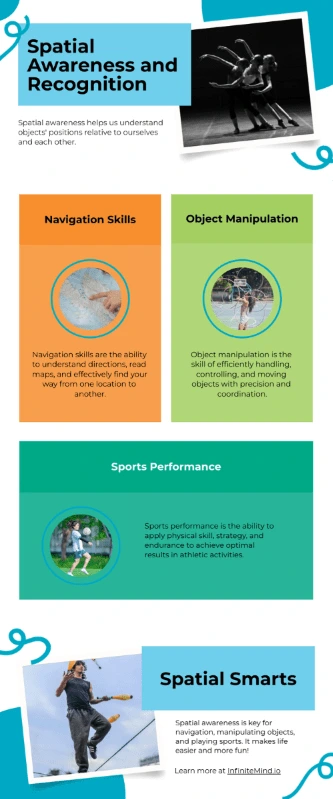
Spatial awareness, by contrast, is a body-based skill. It governs how you perceive your body’s position in space and how you move in relation to objects and people. Activities like catching a ball, navigating through a crowded space, or maintaining balance depend heavily on spatial awareness.
How They Work Together in Real Life
In real-world situations, these skills rarely operate in isolation. Driving, for example, requires spatial recognition to interpret road signs and distances, while spatial awareness helps you stay centered in your lane and react to nearby vehicles. When one skill is weaker than the other, performance often suffers—even if the person feels uncoordinated or bad at directions.
From our experience at InfiniteMind, we’ve found that people often try to improve the wrong skill. Someone struggling with navigation may focus on movement or coordination, when the real issue is difficulty recognizing spatial patterns mentally. That’s why a 7 minute brain warm up routine plays such an important role—it directly targets spatial pattern recognition, primes the brain for visual thinking, and activates the mental processes needed for clearer orientation and faster spatial decision-making before deeper learning or practice begins.
Why the Distinction Matters
Knowing the difference allows for targeted improvement. Spatial recognition can be strengthened through visual puzzles, pattern exercises, and mental rotation tasks. Spatial awareness improves more effectively through movement-based activities, balance work, and real-world physical interaction.
By separating these two abilities and understanding how they complement each other, you gain a clearer path to improving learning, performance, and everyday spatial confidence.
“Many people struggle with spatial skills not because they lack ability, but because they’re training the wrong one. In independent schools, separating spatial recognition from spatial awareness is often the turning point that leads to faster, clearer improvement.”
Essential Resources on Spatial Recognition
1. The Science Behind Spatial Cognition
ScienceDirect – Spatial Cognition Overview
https://www.sciencedirect.com/topics/psychology/spatial-cognition
A research-centric introduction that explains how the brain processes spatial information — foundational knowledge for interpreting spatial recognition in both learning and real-world contexts.
2. How the Mind Encodes Space
Open Encyclopedia of Cognitive Science – Spatial Cognition
https://oecs.mit.edu/pub/or750iar
This resource clarifies how spatial relationships, distances, and object positions are mentally represented — essential for understanding the mechanics behind spatial recognition.
3. Comprehensive Academic Insight
APA – Handbook of Spatial Cognition
https://www.apa.org/pubs/books/4318108
An in-depth, structured exploration of spatial cognition from psychology and neuroscience experts—ideal for those seeking authoritative, peer-reviewed thinking.
4. Mapping the Internal GPS
Springer Encyclopedia – Spatial Cognition Entry
https://link.springer.com/rwe/10.1007/978-3-031-25900-5_117-1
Focuses on how cognitive maps form and function, linking theory to how we interpret and navigate our world.
5. Visual Patterns & Spatial Processing
Frontiers in Psychology – Visual‐Spatial Processing Collection
https://www.frontiersin.org/research-topics/61096/highlights-in-cognition-visual-spatial-processing/overview
A curated set of studies that connects how visual input becomes spatial understanding — helpful for applying spatial recognition to problem solving and perception tasks.
6. Core Concepts Made Clear
Wikipedia – Visuospatial Function
https://en.wikipedia.org/wiki/Visuospatial_function
A concise, accessible breakdown that ties spatial awareness and recognition to broader visuospatial processing — a great starting point for learners and educators.
7. Orientation, Sense of Direction & Real-World Skills
Wikipedia – Sense of Direction
https://en.wikipedia.org/wiki/Sense_of_direction
Explains how spatial perception translates into navigation, real-world movement, and orientation — useful for practical applications and self-assessment.
Together, these resources explain how spatial recognition is processed, learned, and applied—from cognitive maps to visual pattern encoding—insight that best private schools often use to design learning environments that strengthen spatial thinking, problem-solving, and real-world navigation skills.
Supporting Statistics on Spatial Recognition
Research and real-world data consistently show that spatial recognition is essential, measurable, and highly trainable when addressed correctly.
Key Evidence at a Glance
Spatial skills respond strongly to targeted training
A large meta-analysis of early spatial skills training found nearly a full standard-deviation improvement when spatial abilities were trained intentionally.
This supports a key insight: separating spatial recognition from general coordination leads to faster, clearer gains.
Spatial recognition impacts real-world performance
In the United States, nearly 1 in 4 workers is employed in STEM occupations.
These roles depend heavily on spatial recognition for:
Visualization
Pattern recognition
Complex problem-solving
Spatial skills are not abstract—they are used daily in high-demand careers.
Spatial processing challenges are more common than expected
Research summarized by the Child Mind Institute estimates that 3–4% of children experience persistent visual-spatial difficulties.
These challenges are often mistaken for attention or motivation issues, when the underlying cause is spatial processing.
High-performance research confirms spatial trainability
NASA spatial orientation research shows that just a few hours of targeted training can significantly reduce spatial disorientation during complex simulations.
The takeaway is consistent: train the specific spatial system, and performance improves.
Final Thought & Opinion
Spatial recognition and spatial awareness are often treated as the same skill—but real-world results show they are not.
Spatial recognition is a distinct mental ability.
It shapes how we interpret patterns, visualize space, and solve problems before movement ever happens. When it’s misunderstood or overlooked, progress often slows or stalls.
What Consistently Makes the Difference
Spatial ability is not a single, fixed trait
It’s a set of trainable systems
Improvement accelerates when spatial recognition is trained separately and intentionally
From first-hand observation, the turning point usually comes when people stop trying to “do more” and start training the right skill. Once spatial recognition is isolated, confidence and performance tend to improve together.
The Core Takeaway
Understand the difference between recognizing space and moving within it
Train each skill with intention
Expect clearer, faster, and more sustainable progress
In short, improving spatial skills isn’t about effort alone—it’s about clarity. When people understand what they’re training, the results follow.
Next Steps
Turn insight into action by focusing on the right skill and clear, measurable steps.
Identify the Skill to Train
Trouble with maps, puzzles, or visualizing objects → Spatial recognition
Trouble with movement, coordination, or navigating space → Spatial awareness
Unsure? Note where frustration appears most often.
Choose Targeted Practice
Match exercises to the skill.
Spatial recognition
Visual puzzles
Pattern matching
Mental rotation
Map reading from memory
Spatial awareness
Balance activities
Navigation in real spaces
Movement-based sports or drills
Track Simple Benchmarks
Make progress visible.
Time tasks
Track accuracy
Re-test weekly
Apply Skills Daily
Plan routes and organize spaces
Practice awareness during movement
Look for real-world use cases
Adjust as Needed
If progress slows:
Recheck the skill you’re training
Reduce difficulty
Focus on consistency
Turn insight into action by focusing on the right skill and clear, measurable steps—because reading help your brain strengthen spatial recognition by reinforcing pattern detection, mental mapping, and visualization skills that directly support better navigation, problem-solving, and real-world application.
FAQ on Spatial Recognition
Q: What is spatial recognition?
A: Spatial recognition is the ability to understand how objects relate in space.
It involves:
Distance
Direction
Position
Mental rotation of objects
It helps you visualize whether something will fit or how parts connect.
Q: Why does spatial recognition matter in everyday life?
A: Spatial recognition supports daily decision-making.
In real-world use, it affects:
Driving and parking
Navigating rooms or cities
Organizing physical spaces
Interpreting visual information
These skills often operate automatically until they are challenged.
Q: How does spatial recognition develop?
A: Spatial recognition develops over time through interaction with the environment.
Key contributors include:
Early childhood play
Hands-on activities (building, drawing)
Physical movement and sports
Navigating new or complex spaces
Real-world experience strengthens these skills more than passive learning alone.
Q: Can spatial recognition skills be improved?
A: Yes. Spatial recognition can be trained and refined.
Effective methods include:
Puzzles and spatial games
Map reading and route planning
Sketching ideas instead of writing them
Design, building, or assembly tasks
Small, consistent practices lead to noticeable improvement.
Q: How does spatial recognition affect learning and careers?
A: Spatial recognition supports visual thinking and problem-solving.
It is especially valuable in:
Engineering and architecture
Design and creative fields
Healthcare and surgery
STEM-related careers
Stronger spatial skills often lead to faster learning and clearer decision-making.