
See how multi-family office wealth management helps families manage complex finances with greater clarity.
Picture a family with a brokerage account, three trusts, a lake house, and the proceeds from a business they sold last spring. Their wealth is substantial. What they are missing is someone who sees all of it at once, and that gap is exactly what multi-family office wealth management services are built to close.
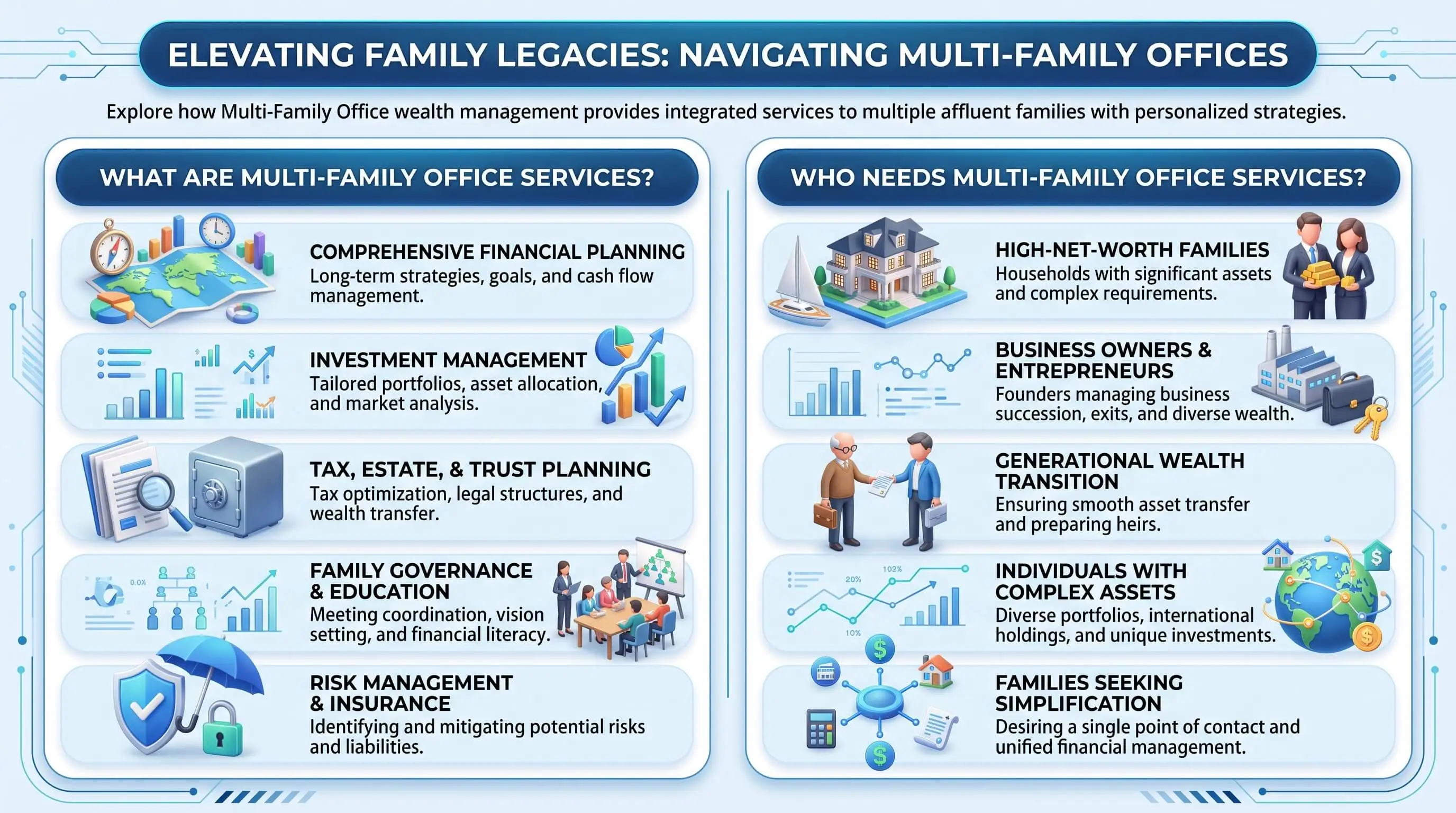
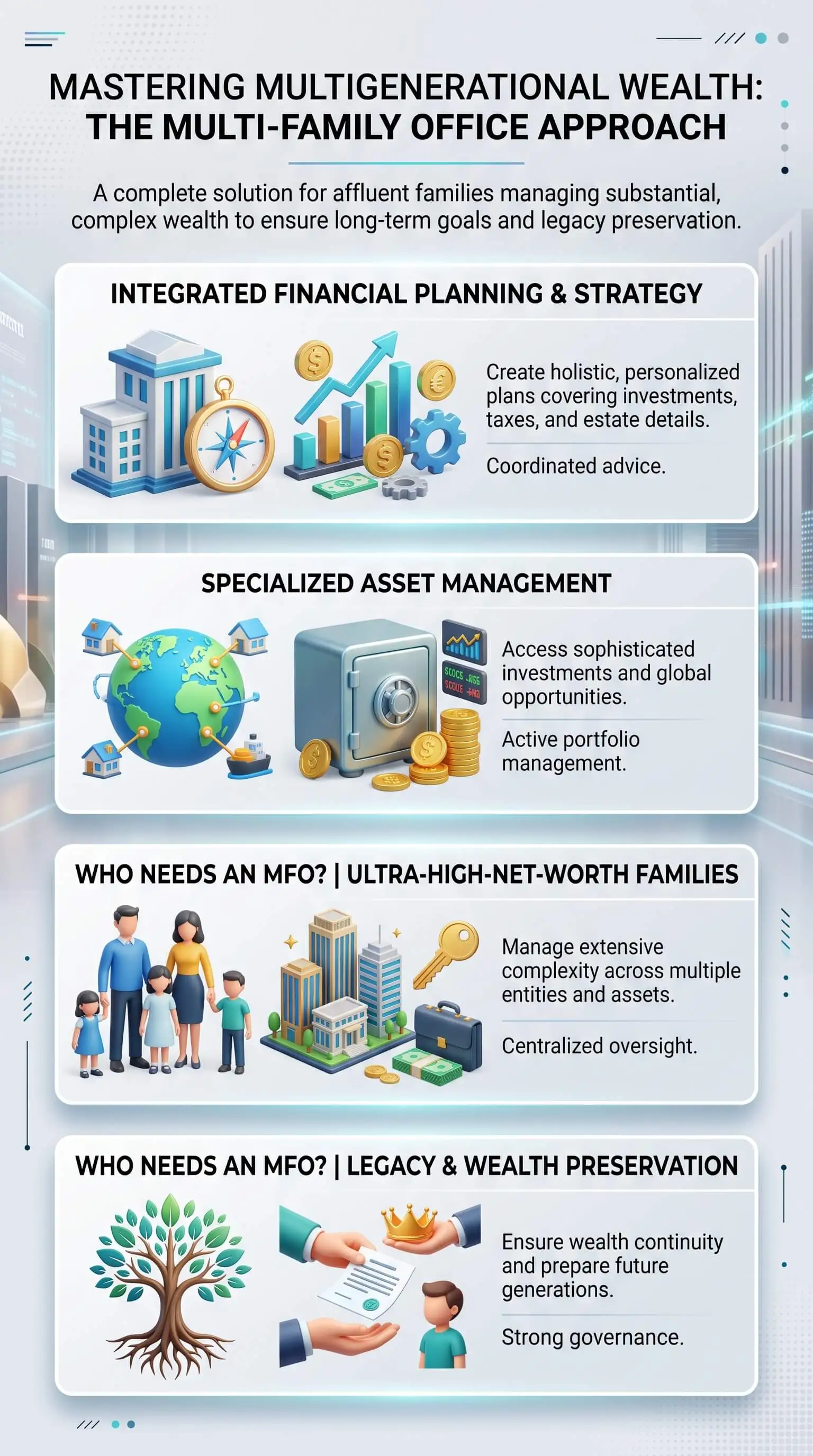
A multi-family office brings investment oversight, tax and estate coordination, trust support, family governance, philanthropy, and reporting into one integrated relationship. Several families share the same team of specialists, so each one gets much of what a private family office provides without hiring its own staff. At its best, the multi-family office becomes the family's financial command center.
Money is only part of the picture. Once wealth reaches this level, the harder questions usually concern people, such as who makes decisions and how the children will learn about what they will one day own. Those questions deserve the same patience and honesty a family brings to any major life transition.
In our first meetings with families managing $10 million or more, we usually find capable advisors giving sound advice that has never been connected.
TL;DR Quick Answers
Multi Family Office Wealth Management Services
Multi-family office wealth management services give families with complex wealth one team that manages the full balance sheet, not just the investment portfolio. Several families share the same specialists, which gives each family much of what a private family office provides at a lower cost.
What they cover: Investment oversight, tax and estate coordination, trust support, family governance, next-generation education, philanthropy, and consolidated reporting.
Who they serve: Families whose finances span trusts, entities, business interests, or several generations, often after a business sale or an inheritance.
What sets them apart: One team keeps your CPA, attorney, and trustee working from the same plan, so decisions reflect the whole picture.
When to consider one: Complexity matters more than a set threshold. Legacy Bridge works with families managing $10 million or more, and many firms start at $25 million to $50 million.
How fees work: Usually a percentage of assets, a flat retainer, or a hybrid of the two.
Top Takeaways
A multi-family office coordinates investments, tax, estate, trusts, governance, philanthropy, and reporting through one relationship that starts with the full balance sheet.
Complexity is a better guide than any single net worth threshold.
Families usually arrive after a business sale, an inheritance, or years of advisors who never compared notes.
A good multi-family office works alongside your existing CPA and attorney instead of replacing them.
What a Multi-Family Office Actually Does
A multi-family office starts with the full balance sheet and builds the plan outward from there. Investments matter, but they are one piece of a larger structure that includes trusts, entities, real estate, business interests, charitable vehicles, and the people who will eventually inherit all of it.
Most traditional wealth managers begin with the portfolio. That works well for many families. Once the balance sheet spreads across several advisors and structures, though, someone needs to keep the whole picture in view. The family's CPA, estate attorney, and trustee stay in place. The multi-family office makes sure they are working from the same plan, so the family no longer has to carry messages between them.
Core Multi-Family Office Services
Investment oversight: Asset allocation, manager selection, liquidity planning, and risk management across public and private holdings.
Personal CFO: Cash flow, liabilities, tax timing, and follow-through on the big decisions.
Tax coordination: Working with the family's CPA throughout the year, so tax shapes decisions before they are made.
Estate and trust coordination: Keeping estate documents, trust funding, titling, and beneficiary designations in agreement with each other.
Family governance: Family meetings, clear decision-making, and shared expectations about wealth.
Next-generation education: Helping heirs understand trusts, investments, and what will be asked of them.
Philanthropic planning: Structuring giving through donor-advised funds, foundations, or charitable trusts.
Reporting and administration: One consolidated view across custodians, entities, and trusts, plus the paperwork that quietly piles up.
Families notice the benefit of multi family office wealth management services most when all eight services work from the same information, because decisions get easier and faster to make.
Multi-Family Office vs. Wealth Manager vs. Single-Family Office
Traditional wealth manager: A good fit for affluent and high-net-worth individuals whose needs center on investments and financial planning. Entry points often run from $1M to $10M+.
Multi-family office: Built for families with complex wealth and planning needs that cross several disciplines. Entry points often run from $25M to $200M+, and some firms start near $10M.
Single-family office: One family's private, fully staffed team. It usually makes sense only at $100M to $250M+, because the family carries every salary and system itself.
The right choice gives your family the clarity and accountability it needs at a cost the complexity justifies.
Who Needs Multi-Family Office Wealth Management Services?
Complexity decides this more than net worth does. Published minimums vary widely, and we regularly meet two families with similar assets and completely different needs.
You may be a good fit if several of these sound familiar:
You recently sold a business or had another large liquidity event.
You inherited significant assets, or expect to soon.
You hold assets in multiple trusts, LLCs, or family entities.
Your CPA, attorney, and investment advisor rarely talk to one another.
One company, stock, or property makes up a large share of your net worth.
You want your children or grandchildren ready for what they will receive.
Giving has become a meaningful part of your family's plans.
Business owners tend to feel it first. The same discipline that leads a growing company to bring in outsourced accounting support applies at home once personal and business wealth begin to overlap.
Signs You May Not Need One Yet
Some families are better served elsewhere, and we say so when that is the case. With a simple balance sheet, no trusts or entities to coordinate, and one advisor who already covers your planning, a strong wealth manager is probably enough. Broader coordination should pay for itself in the complexity it removes.
How the First 90 Days Usually Work
The first few months should leave a family with more clarity and less to manage, not the other way around.
Discovery. We gather statements, tax returns, estate documents, trust agreements, and entity records.
One balance sheet. Assets, liabilities, ownership, and liquidity come together in a single view, often for the first time.
Gap review. We check trusts, estate documents, tax exposure, insurance, and concentrated positions for what is current and what has drifted.
Advisor alignment. Every open item gets an owner, whether that is our team, the family's CPA, or outside counsel.
A working plan. The family leaves with a prioritized agenda and a regular rhythm for reviewing it.
"When a family first sits down with us, we usually find capable advisors who have never been in the same room. The estate plan might assume one thing while the portfolio assumes another, and the tax return often reflects decisions nobody coordinated. Adding more advice rarely helps. Families need one team that holds the full picture, keeps a running list of open items, and makes sure the next generation understands the plan before inheriting it. Clarity is what they end up valuing most."
Essential Resources
We share these with families who want to understand their options before they talk to any firm, including ours.
1. Verify an Adviser's Registration and Disclosures
The SEC's public database shows any registered investment adviser's Form ADV and disciplinary history. Check every firm you are considering here before the first meeting.
Source: https://adviserinfo.sec.gov/
2. Choosing the Right Family Office Model
Morgan Lewis compares single-family, multi-family, hybrid, and outsourced models in this July 2026 analysis. Its warning that families tend to weigh asset size too heavily and complexity too lightly matches what we see in practice.
3. Four Signs a Family May Need a Family Office
Kiplinger describes the point where wealth starts to feel like running a family business. The four scenarios make a quick, honest gut check.
4. How Multi-Family Office Minimums and Fees Work
Asset Vantage covers typical thresholds, the three common fee structures, and the questions worth asking during evaluation. Read it if published minimums have left you confused.
Source: https://www.assetvantage.com/blogs/multi-family-office-minimum-net-worth/
5. The Great Wealth Transfer
Cerulli's December 2024 research sizes the wealth expected to pass to heirs and charities through 2048. It explains why preparing the next generation has moved to the center of family planning.
6. Understanding Donor-Advised Funds
The IRS explains how donor-advised funds work and what the rules allow. Families with active giving should read this before choosing between a fund and a private foundation.
Source: https://www.irs.gov/charities-non-profits/charitable-organizations/donor-advised-funds
7. A Primer on the Multi-Family Office Model
Aleta's guide explains how multi-family offices spread costs across client families while keeping service personal. It is a good starting point if the concept is new to you.
Source: https://aleta.io/knowledge-hub/multi-family-offices-a-complete-guide
These resources help families understand family office structures, adviser oversight, wealth transfer, fees, philanthropy, and outsourced family office executive services so they can evaluate the right level of coordination for their complex financial needs.
Supporting Statistics
Each of these numbers shows up in the conversations we have with families weighing a multi-family office.
1. $124 Trillion Is Expected to Change Hands Through 2048
Cerulli projects $105 trillion of that total will go to heirs and $18 trillion to charity.
High-net-worth and ultra-high-net-worth households make up only 2% of all U.S. households, yet they account for more than half of the projected transfers.
We have found that families who prepare their heirs before a transfer face far fewer surprises after it.
2. An Estimated 6,000 to 7,300 Family Offices Operate in the U.S.
Kiplinger reports this range from Family Office Exchange, and traces the model back to the 1800s and families such as the Rockefellers and Carnegies.
A multi-family office offers the same kind of coordinated structure to families who would rather not build and staff their own.
3. Many Families Start Considering a Multi-Family Office at $25 Million to $50 Million
Asset Vantage puts the typical starting range at $25 million to $50 million in investable assets and says a single-family office usually requires $100 million or more.
We work with families managing $10 million or more. In our experience, the number on the statement matters less than how many moving parts sit behind it.
Source: https://www.assetvantage.com/blogs/multi-family-office-minimum-net-worth/
These statistics highlight the growing complexity of intergenerational wealth, the expanding use of family office structures, and the point at which families may need coordinated support from outsourced business and financial accounting firms alongside broader multi-family office services.
Final Thoughts
Whether a family needs multi-family office wealth management services depends on whether it can see its full financial picture and act on it with confidence.
Our view is that complexity should drive the decision far more than net worth. We have met families with modest balance sheets and a tangle of trusts, entities, and advisors who needed coordination badly, along with wealthier families whose simple holdings were well served by one good advisor. Either outcome is fine. The trouble starts when a family never asks the question.
Two things come up in almost every relationship we start. Families rarely lack good advisors, although they almost always lack one team connecting them. The hardest questions also tend to be about people rather than portfolios, which makes them decision-quality problems more than investment problems.
That is where wealth planning and personal growth overlap. A business sale, an inheritance, or a retirement is a financial event and a life transition at the same time. The families who handle those moments well usually pair sound financial structure with the kind of reflection that comes from working with a coach through major transitions.
If your family's wealth has become harder to explain than it is to own, a coordinated approach is worth exploring.
Frequently Asked Questions
What are multi family office wealth management services?
They are coordinated advisory services for families with complex wealth. A multi-family office oversees investments, works with the family's CPA and attorney on tax and estate planning, supports trusts and family governance, guides philanthropy, and consolidates reporting. Several families share one team of specialists instead of each building its own office.
What is the minimum net worth for a multi-family office?
There is no universal number. Many multi-family offices start at $25 million to $50 million in investable assets, and some begin closer to $10 million. Legacy Bridge works with families managing $10 million or more, and we decide fit based on how complex the family's finances are.
How is a multi-family office different from a financial advisor?
Most financial advisors concentrate on investments, retirement, and financial planning. A multi-family office also handles tax coordination, estate and trust coordination, family governance, next-generation education, philanthropy, and administration. The biggest difference is accountability: one team is responsible for the whole balance sheet.
How is a multi-family office different from a single-family office?
A single-family office is one family's private team, and the family pays for every salary and system. A multi-family office shares its team across several families. Each family gets similar capabilities at a lower cost, without hiring or managing staff.
How do multi-family offices charge for their services?
Most charge a percentage of assets under management, a flat annual retainer, or a mix of the two. Ask for fees and included services in writing, and find out whether the firm earns anything from products or third parties.
Can a multi-family office work with my existing CPA and attorney?
Yes, and a good one will insist on it. The goal is to keep your CPA, estate attorney, trustee, and other advisors working from the same plan, so you stop being the go-between.
Talk Through Your Family's Complexity
Most families we meet already have plenty of advice. What they want is for that advice to add up to one clear strategy. Legacy Bridge Private Family Offices is an independent, SEC-registered fiduciary based in West Des Moines, Iowa, and we work with families nationally to bring their investments, planning, and people into alignment through family office trust and business transition services.
One call. One team. One coordinated strategy. Schedule a private consultation with Legacy Bridge to find out whether a multi-family office fits your family.