
That's a fair thing to want to know before you sit across from a stranger and start talking to your inner critic.
Here's IFS therapy explained in a sentence. It's a form of talk therapy built on the Internal Family Systems model, which treats your mind as a set of parts with a steady Self underneath, and it gets curious about what each part has been protecting instead of trying to shut it up.
The people who reach out to me have usually read two kinds of articles by then. One calls IFS life-changing. The other calls it unproven, or worse.
Each of them is holding a piece of the picture, and both deserve a fair hearing before you decide anything.
TL;DR Quick Answers
IFS Therapy Explained
IFS (Internal Family Systems) is a talk therapy that sees your mind as a set of inner parts, each one trying to protect you, with a calm, curious Self underneath. Instead of fighting anxiety or the inner critic, it asks what that part is afraid would happen if it stopped.
The short version:
Who built it? Richard Schwartz, a family therapist, in the 1980s.
The parts. Managers keep the day under control, firefighters put out sudden pain fast, and exiles carry the older hurt.
The goal. Let Self lead, so protective parts can ease off instead of being forced out.
What a session feels like. Slow and curious, one part at a time, and a "not yet" gets respected.
Where it can go wrong. Rushed work, pressure on memories, or use with psychosis or dissociative identity disorder.
What the evidence says. Small trials for PTSD, depression, and chronic pain look promising, and larger studies are still needed.
Top Takeaways
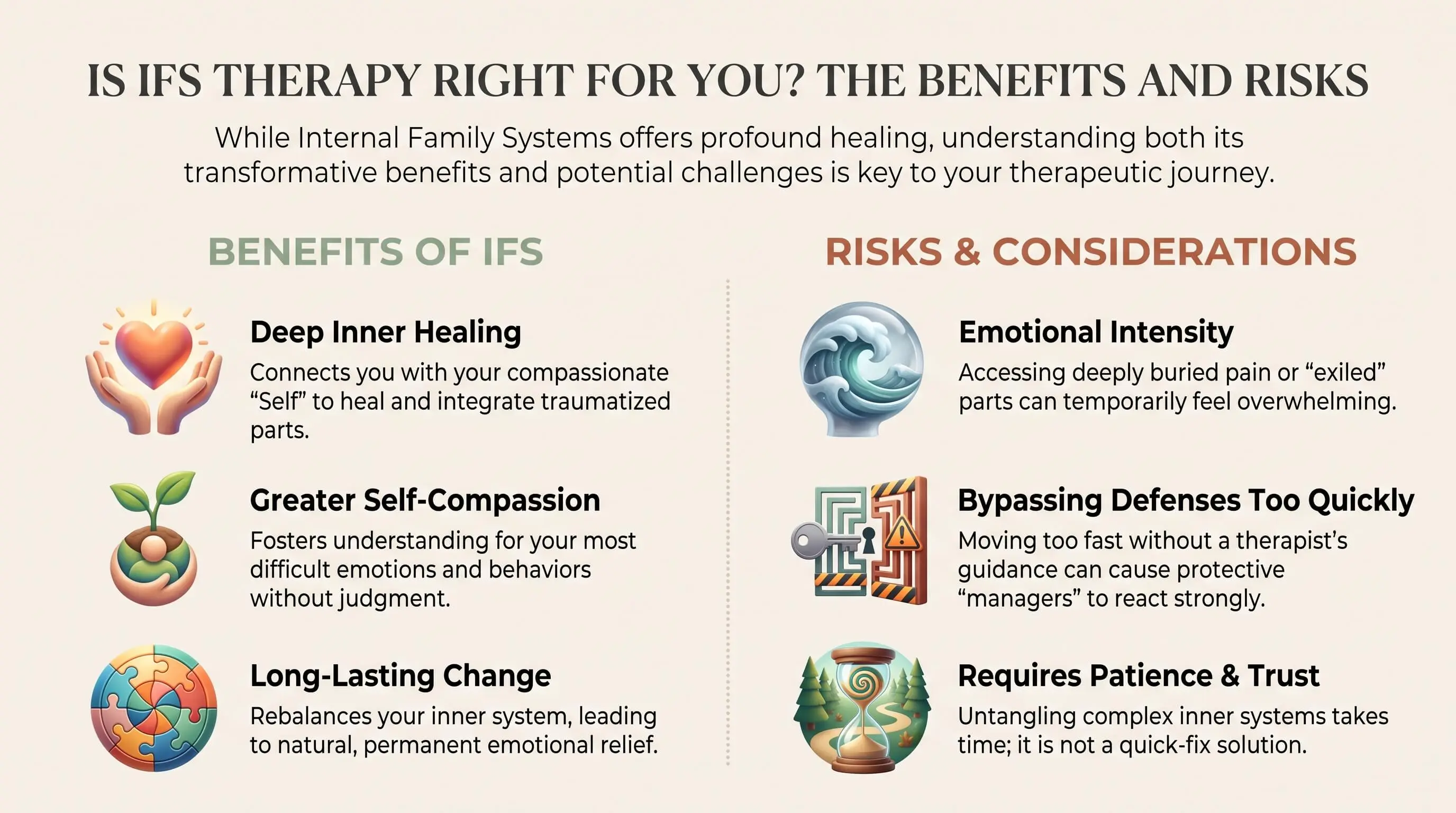
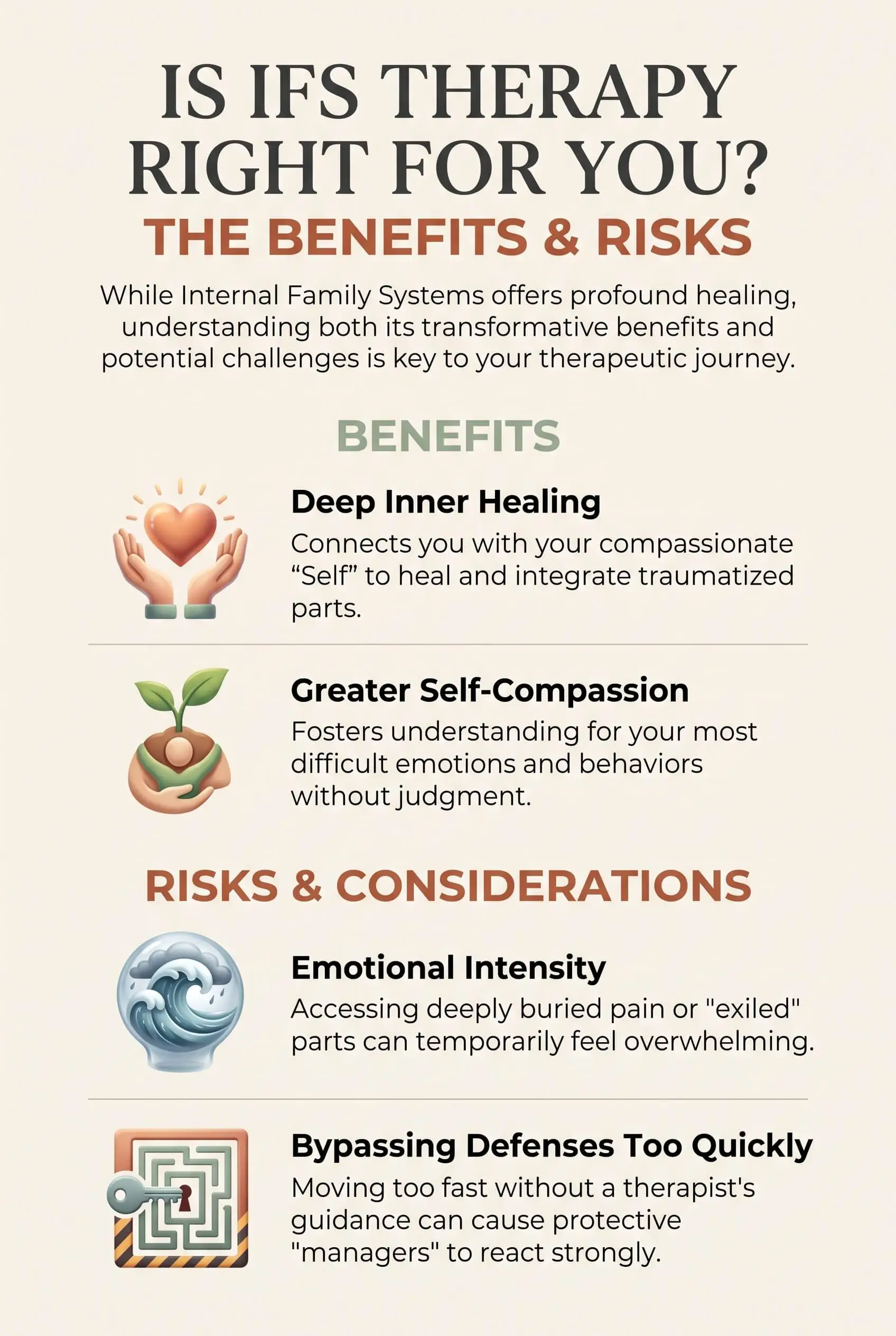
The Upside Is Worth Knowing. Gentler self-talk, and a way into old pain at a pace you control.
So Is The Downside. The research is young, and rushed work can cause harm.
Some People Should Start Elsewhere. Psychosis, reality-testing struggles, or dissociative identity disorder call for a clinician's input first.
Ask About Training Before You Book. License, IFS level, and trauma background all matter.
Slow Is The Safety Feature. A good IFS therapist respects every "not yet" a part offers.
IFS Therapy Explained In Plain Language
IFS works with the different parts of you, and with the calm Self beneath them, without asking you to fight or evict any of them. Having IFS therapy explained in simple terms helps you understand how this compassionate approach encourages self-awareness, emotional healing, and greater inner balance.
Richard Schwartz developed the model in the 1980s. He was a family therapist then, and he kept hearing clients describe their inner lives the way people describe a tense holiday dinner. One part wanted to speak up. Another wanted to keep the peace. Somebody quietly left the room.
IFS gives those parts loose job titles:
Managers. They run the day. Planning ahead and criticizing, all in the hope that nothing catches you off guard.
Firefighters. They show up when pain breaks through anyway. Three hours of scrolling, an early glass of wine, a sharp word to someone you love. Quick relief, messy aftermath.
Exiles. They carry the older hurt, and the other two spend enormous energy keeping them out of sight.
Under all of that sits what IFS calls Self (steady and curious, with plenty of room to care). You don't have to build it. The work makes enough room for it to lead.
For the fuller walkthrough of parts, Self, and what a session looks like, here's a plain-language explanation of IFS therapy. Understanding this approach also supports the broader importance of health and wellness as fundamental human rights, including access to clear, trustworthy mental health information.
What Are The Benefits Of IFS Therapy?
The benefit people tend to notice first is gentler self-talk. Close behind it comes a way into old patterns that doesn't feel like an interrogation, at a pace you get to set.
Self-Compassion Instead Of Self-Attack
Most of us learned early to argue with our worst feelings. IFS asks a different question: what is this part afraid would happen if it stopped? For a lot of people, the inner critic starts to look less like an enemy and more like a guard nobody has relieved in decades.
Help With Patterns That Keep Coming Back
IFS tends to fit people whose struggles show up as repeats. The same relationship knotted for the fourth time. Perfectionism that never takes a day off. Anxiety with a voice you'd recognize anywhere. Layered, long-running trauma often belongs here too.
A Pace You Set
Protective parts give permission before anything deeper happens. When a part says not yet, I listen, and we wait.
For anyone who felt pushed in past therapy, that alone can change how the room feels.
Evidence That's Promising And Still Young
Small trials and pilot studies have tested IFS for PTSD, depression, and chronic pain, and the results are encouraging. A 2025 scoping review in Clinical Psychologist called it promising and asked for larger studies. That's progress, and I'd stop well short of calling it proof.
What Are The Risks Of IFS Therapy?
Most of the risks trace back to research that's still thin and to therapists who move faster than a client's system can handle. Fit matters too, because IFS doesn't suit every condition.
The Research Hasn't Caught Up With The Popularity
IFS made it onto a federal registry of evidence-based practices in 2015, and SAMHSA shut that registry down in 2018. The published IFS research is still a fraction of what exists for CBT or EMDR. Anyone telling you IFS is proven is getting ahead of the studies.
Some People Should Start Somewhere Else
Clinicians urge caution for people with psychosis, trouble telling inner experience from outside reality, or dissociative identity disorder. Turning toward inner parts feels grounding for most people. For a few, it can be disorganizing, which is why a good therapist screens before starting.
Pressure Can Shape Memories
When a therapist asks leading questions or pushes a part to reveal trauma, memories can take shape that didn't happen that way. Careful IFS work holds whatever surfaces lightly and doesn't rush it. Pressure is the warning sign to watch for.
Training Varies A Lot
Plenty of therapists call themselves IFS-informed after a weekend workshop. Others have years of formal training and consultation behind them. Both may be kind and well-meaning. They're still offering different things.
Going Too Fast Can Backfire
Protective parts are there for a reason. Push past them and people can leave a session more shaken than when they arrived.
In IFS, slowness is the safety feature.
Is IFS Therapy Right For You?
IFS often suits people who understand their patterns but can't seem to shift them. It's a poorer fit for anyone in crisis or struggling with reality testing.
It may suit you if:
You're hard on yourself and tired of it.
Past therapy helped you cope but never quite reached the root.
Your history feels layered rather than tied to one event.
Curiosity appeals to you more than worksheets.
Talk with a clinician about other options first if:
You're in crisis, or having thoughts of harming yourself.
A clinician has diagnosed you with a psychotic disorder or dissociative identity disorder.
And if you want something short and skills-first, CBT may suit you better.
IFS Therapy Vs. Life Coaching
Coaching works on goals and the follow-through to reach them. IFS is clinical therapy for inner patterns and old pain. The two can sit side by side, though one can't stand in for the other. A good coach knows what coaching can and can't do and refers out when trauma shows up.
Questions Worth Asking An IFS Therapist
Are you licensed, and in which state?
What IFS training have you completed, and at what level?
What trauma training do you have outside IFS?
How do you handle memories that come up in session?
What happens if a part of me says no?
A good therapist will be glad you asked.
"People usually ask me whether IFS is safe as if the safety lives in the method. In my experience, it lives at a pace. When I slow down and let a protective part tell me no, something in the room settles, and the work goes deeper from there. The harm I hear about almost always starts the other way, with someone in a hurry to reach the pain. If a therapist can't sit with your hesitation, keep looking."
Essential Resources
These are the places I'd point you next. A few are friendly to IFS, a couple are openly skeptical, and I chose them that way on purpose.
1. Get A Plain Overview Of IFS And Where Its Research Stands
GoodTherapy walks through parts, Self, typical sessions, and what the studies do and don't show yet. A good next read if this page raised more questions than it settled.
Source: GoodTherapy — Internal Family Systems (IFS) Therapy
2. Hear The IFS Institute Speak For Itself On Memories And Safety
After critical press coverage in late 2025, the IFS Institute set out its position, including that it doesn't treat newly recovered memories as fact without corroboration. Worth reading in the organization's own words.
Source: IFS Institute — Response to New York Magazine Article
3. Look Up A Therapist's IFS Training Level
The IFS Institute directory lists practitioners by training level and certification. Practitioners supply their own listing details, so check the license with your state board as well.
Source: IFS Institute — IFS Directory
4. Know What Trauma-Informed Care Should Feel Like
SAMHSA lays out what trauma-informed care rests on, including safety, trust, and collaboration. Any IFS therapist should be practicing all of it, whatever else they call their work.
Source: SAMHSA — Trauma-Informed Approaches and Programs
5. Bring Better Questions To Your First Call
The National Institute of Mental Health suggests asking any therapist what approach they use and what evidence sits behind it. Jot a few down before you dial.
Source: NIMH — Psychotherapies
6. Understand How Therapy Works, Whatever The Method
The American Psychological Association covers what should and shouldn't happen in a session, and why the relationship with your therapist carries so much weight. Read it before you settle on a modality.
Source: APA — Understanding Psychotherapy and How It Works
7. Know Where To Turn If Things Feel Urgent
If you're in crisis, start here rather than with any type of therapy. The 988 Lifeline is free and confidential by call, text, or chat, at any hour.
Source: 988 Suicide & Crisis Lifeline
Supporting Statistics
A few numbers I keep in mind when someone asks me whether IFS is worth trying.
1. 45,764 Therapists On Psychology Today Listed IFS As Of April 2024
Researchers writing for the Society for the Advancement of Psychotherapy counted that figure while reviewing how fast IFS has spread.
They argued its use has moved beyond what the research has tested so far, especially for people with psychosis or difficulty with reality testing.
What I notice: a long list of IFS therapists tells you the model is popular. It says nothing about who trained where, so ask.
2. A 2026 Randomized Trial Of 60 Adults With PTSD Found Both Groups Improved
Thirty people joined an online IFS-based group program, and thirty joined a nature-based stress reduction program built as an active comparison.
Clinician-rated PTSD symptoms dropped significantly in both groups, with no significant difference between them.
The IFS group attended more sessions and reported higher satisfaction.
What I notice: people kept coming back. In trauma work, a program people stick with has already cleared a hurdle many don't.
Source: Beth Israel Deaconess Medical Center — PARTS Randomized Controlled Trial
3. 53% Of Participants In A 2024 Pilot Saw A Meaningful Drop In PTSD Symptoms
Thirteen adults with PTSD completed 24 weeks of online group and individual IFS sessions.
Just over half saw at least a 10-point reduction on a clinician-administered PTSD scale.
What I notice: thirteen people is where research starts. I'd rather say that plainly than round it up into proof.
Source: Healthline — Internal Family Systems (IFS) Therapy: Parts Work for Healing
Research shows that IFS therapy has grown in popularity, although evidence supporting its effectiveness is still developing. Recent studies report improvements in PTSD symptoms, encouraging participation, and high satisfaction among participants. These findings may also be relevant to mental health discussions in independent schools, where understanding emotional struggles, protective behaviours, and access to appropriate support can help promote student well-being.
Final Thoughts And Opinion
Take IFS seriously, and take your own hesitation seriously too.
That's most of what I'd tell a friend who asked. IFS therapy explained without the hype is a gentle, promising approach whose research is still catching up, and whose safety depends heavily on the person sitting across from you.
Where I've landed after years of this work:
Most of the harm comes from how it's done. Rushing the work, or treating whatever surfaces as literal history. Those are failures of practice, and a careful therapist avoids them.
My unpopular opinion. The skeptics are doing IFS a favor. Hard questions about evidence keep therapists careful, and careful is what this work needs.
Fit beats the label. If IFS doesn't sound like your language, another approach may serve you better, and that's a perfectly good outcome for this page.
Some goals don't need therapy at all. If you want momentum on a plan rather than relief from an old pattern, a coach may suit you. Here's a useful look at who tends to benefit from working with a life coach.
People usually come in hoping to get rid of a part.
What tends to happen is slower and kinder than that. The part that's been on duty for years finally gets to sit down.
Frequently Asked Questions
Q: Is IFS Therapy Safe?
A: For most adults, yes, when a well-trained therapist goes slowly. The risk climbs when the work is rushed, when memories get treated as fact without care, or when IFS is used with conditions it doesn't suit.
Q: Who Should Not Do IFS Therapy?
A: Anyone with psychosis, serious trouble with reality testing, or dissociative identity disorder should talk with a clinician before starting. The same goes for anyone in an active crisis. Getting steady usually comes first.
Q: Is IFS Therapy Evidence-Based?
A: Partly. IFS joined a federal evidence registry in 2015, and that registry closed in 2018. Small trials for PTSD, depression, and chronic pain look promising, and a 2025 scoping review asked for larger studies. I'd rather tell you that plainly than oversell it.
Q: Can IFS Therapy Cause False Memories?
A: It can, when a therapist leads the client or treats whatever surfaces as literal history. The IFS Institute says it doesn't accept newly recovered memories as fact without corroboration. Unhurried, careful work lowers this risk a great deal.
Q: How Is IFS Different From CBT And EMDR?
A: CBT works mostly on thoughts and behavior, with structured skills. EMDR goes straight to traumatic memory. IFS comes at things through your relationship with your inner parts, asking what each one protects before going any deeper.
Q: Can I Try IFS On My Own?
A: Gentle noticing is fine for most people, like naming which part showed up in a hard moment. Deeper work with painful memories is safer alongside a trained therapist, especially if your history includes trauma.
Q: How Do I Find A Qualified IFS Therapist?
A: Start with the IFS Institute directory, then confirm the license with your state board. Ask about their IFS training level, their trauma training, and what they do when a part says no.
If You'd Like To Talk It Through
If you're still weighing whether IFS fits, you don't have to work it out alone. Lauren Rath Therapy offers a free 15-minute call for questions, skeptical ones included, with no pressure in either direction. A line or two is plenty to get started.