
The Santa Barbara owners who call us about messy books usually tell the same story. Summer got busy, nobody opened the bank feed for six weeks, and now a sales tax prepayment is due on the 24th. Month-end has turned into guesswork.
We've closed a lot of months for State Street shops, coastal nonprofits, wineries, and professional firms. The gaps we find look remarkably alike, and they almost always close with a routine rather than more hours. Ten steps, run in the same order every month, will keep your books current and your filings on time.
Below is the version we'd hand a new client on day one, with the city and state deadlines that generic checklists skip. Run it yourself for as long as it works. When it stops working, that's the moment a Santa Barbara bookkeeper earns their keep.
TL;DR Quick Answers
Santa Barbara Bookkeeper
A Santa Barbara bookkeeper reconciles and closes your books every month and tracks the city and California deadlines that national checklists miss, so you get clean numbers with zero guesswork at month-end.
What they handle: Transactions, bank and card reconciliations, payables, receivables, payroll support, and monthly financial statements.
Local deadlines they track: The City of Santa Barbara Business Tax Certificate (renewed by January 31), CDTFA sales tax and prepayments (due the 24th), and EDD payroll deposits.
Why monthly matters here: Seasonal revenue cycles in hospitality, retail, wine, and nonprofit work make month-to-month visibility worth more in Santa Barbara than in steadier markets.
When to hire one: Your books are 30 or more days behind, you've added employees, sales tax has moved you to quarterly prepayments, or a lender or board wants monthly statements.
Where Accountix fits: We support Santa Barbara businesses and nonprofits with monthly bookkeeping and step up to outsourced accounting or fractional CFO guidance as you grow.
Top Takeaways
Run the same 10 steps every month, in the same order.
Reconcile every bank and card account against its statement.
Keep CDTFA and EDD deadlines inside your monthly close, where you'll actually see them.
Renew your City of Santa Barbara Business Tax Certificate by January 31.
Bring in a Santa Barbara bookkeeper once the routine starts slipping.
Why a Monthly Routine Matters for Santa Barbara Businesses
Santa Barbara revenue rarely moves in a straight line. Hospitality and retail swell with summer visitors, while wineries feel harvest costs months before the sales come in. Close your books every month and you'll see those seasonal revenue cycles while there's still time to adjust.
Bookkeeping is the record underneath all of it. Each transaction posts to your general ledger, and at period-end those balances roll up into the trial balance and financial statements that bookkeeping feeds, which are what lenders, boards, and your tax preparer actually read. Skip a month and that work waits for you, usually bigger than you left it.
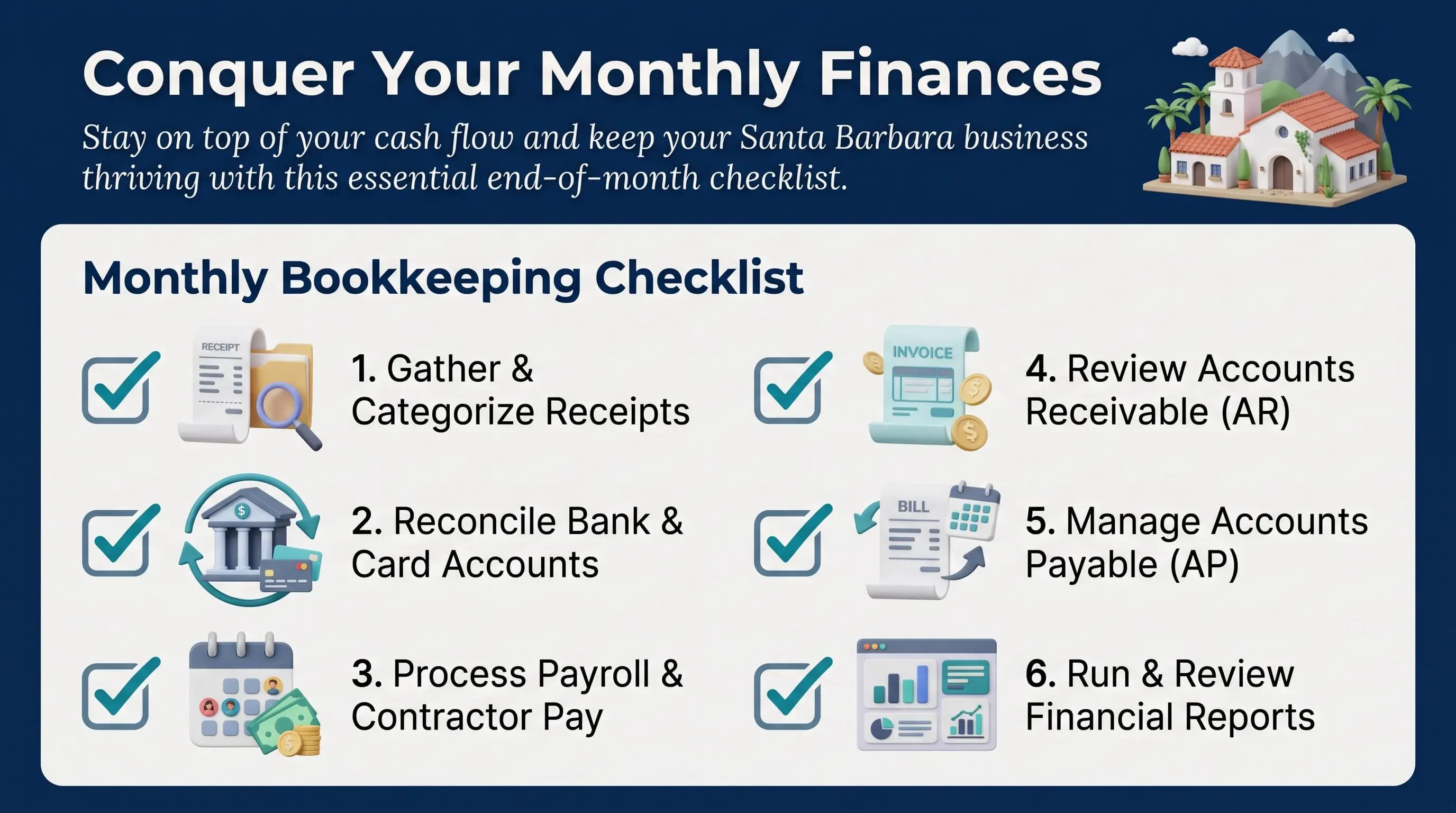
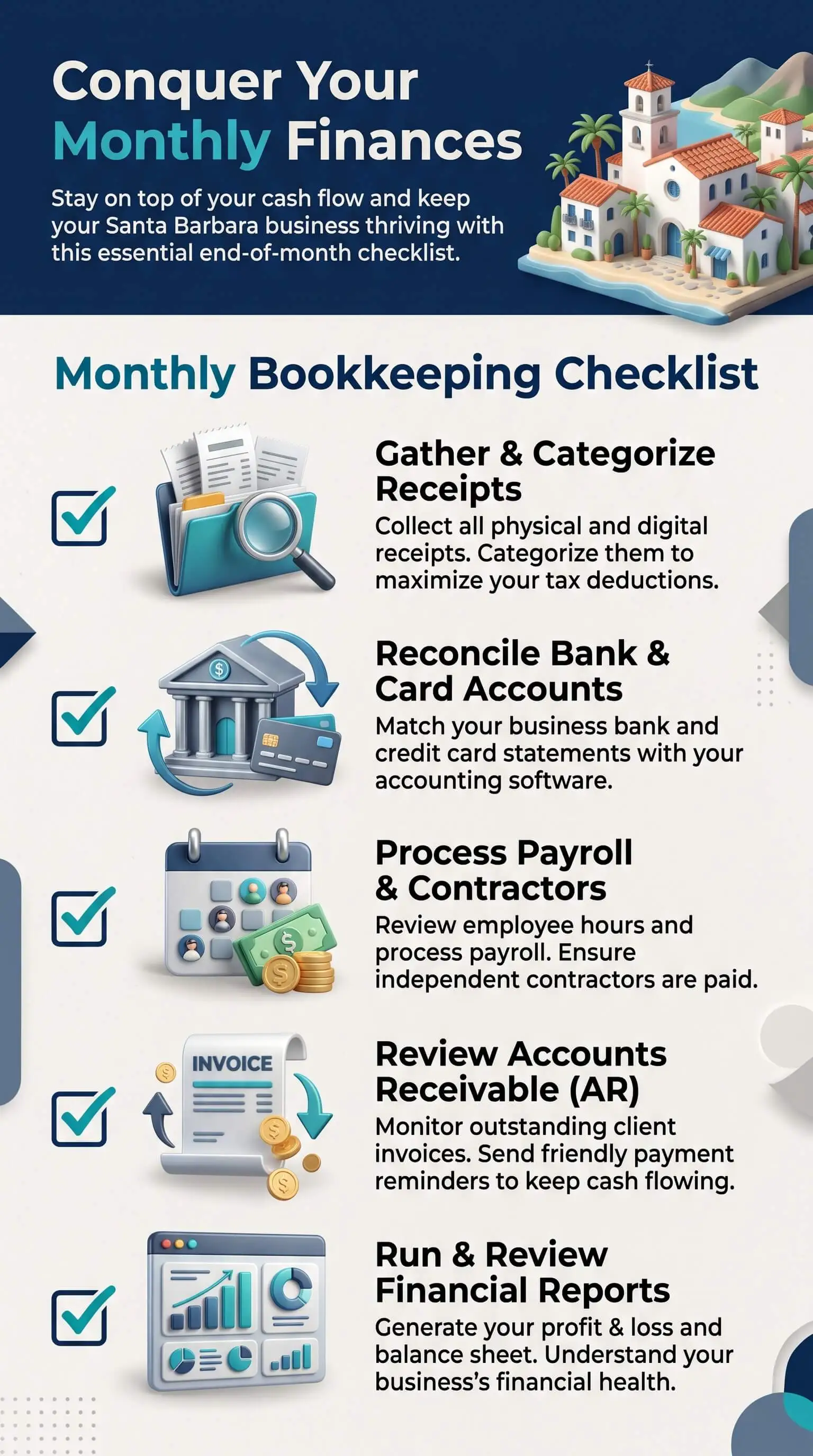
The Monthly Bookkeeping Checklist, Week by Week
We spread the work across four weeks so no single afternoon turns into a marathon. Once the routine settles in, most of the small businesses we support spend a few focused hours a month on it.
Week 1: Capture Every Transaction
Collect and attach receipts. Match every expense to its receipt or invoice inside your accounting software. The IRS expects you to keep records that support the income and expenses you report, and a receipt you can't find today is a deduction you can't defend later. The IRS recordkeeping guidance spells out what to keep.
Categorize every transaction. Work through the bank feed and assign each item to the right account in your chart of accounts. Restaurant, retail, and travel charges deserve a second look, since they're the ones that need a clear business purpose.
Pull out personal spending and owner transfers. A business bill paid from your personal card, or a personal purchase on the company card, should be posted as an owner contribution or draw. Moving money between your own accounts isn't income, and it isn't an expense either.
Week 2: Reconcile and Chase Cash
Reconcile every bank and credit card account. Tie each one to its statement, line by line. Recording the card payment doesn't mean the card is reconciled, and this is the step owners skip most often.
Check your receivables aging. See who owes you and for how long. A reminder sent the week an invoice goes past due gets paid far more often than one sent a month later.
Line up payables. Confirm what's due, catch duplicate bills, and time payments around your cash position. Heading into a slow season, this matters more than almost anything else on the list.
Week 3: Payroll and Sales Tax
Confirm payroll entries and state deposits. Make sure wages, withholdings, and employer taxes posted correctly. California employers submit deposits on the Payroll Tax Deposit (DE 88), and your deposit frequency depends on your federal deposit schedule plus how much state income tax you withhold. Unemployment Insurance and Employment Training Tax contributions are due quarterly, along with the DE 9 and DE 9C wage reports. The EDD deposit requirements lay out every schedule.
Record and prepare sales tax. CDTFA assigns each seller a filing frequency based on its taxable sales. On a quarterly prepayment basis, you'll owe prepayments for the first two months of each quarter by the 24th of the following month. Check your exact dates on the CDTFA filing schedule.
Week 4: Review, Close, and Lock
Run and read your financial statements. Pull the profit and loss, balance sheet, and cash flow statement. Compare them with last month, then with the same month last year. For a seasonal business, that second comparison tells you far more.
Close the period and back it up. Lock the month in your software so nothing shifts after reports go out, and back up your data. Every clean close gives next month a solid starting point.
The Santa Barbara Compliance Layer
Most national checklists stop at reconciliations and reports. Here, you've got a city certificate and two state agencies to keep happy, and your monthly routine is the easiest place to keep them in view.
City of Santa Barbara Business Tax Certificate: Required for anyone doing business inside city limits, home-based and part-time businesses included. File within 30 days of opening. Certificates expire December 31, and you have until January 31 to renew without a late penalty.
California sales and use tax (CDTFA): Applies if you sell taxable goods. CDTFA decides whether you file monthly, quarterly, quarterly with prepayments, or yearly.
California payroll taxes (EDD): Applies once you have employees. Your deposit schedule follows your federal deposit schedule and state withholding, with returns and wage reports due every quarter.
Put the January 31 renewal on your December checklist so it doesn't get buried in the holiday rush. The city's Business Tax Certificate page has the details.
When to Hand It Off to a Santa Barbara Bookkeeper
A checklist only works if someone actually runs it every month. Here's what we usually hear from owners who've reached the point where doing it themselves costs more than it saves:
The books are more than 30 days behind, and catching up keeps sliding to next week.
You've hired employees, so payroll deposits now run on a schedule someone has to watch.
Sales tax has grown enough to put you on quarterly prepayments.
A lender, investor, or board wants monthly financial statements.
Your evenings go to Santa Barbara bookkeeping services instead of the business.
If two or more of those sound familiar, it's time to bring in a Santa Barbara bookkeeper. At Accountix, we run this routine for local businesses and nonprofits every month, reconcile every account, and deliver clean numbers with zero guesswork at month-end. As you grow, that same team can step up to outsourced accounting or fractional CFO guidance.
"The owners who call us after a rough month-end are almost never careless. They're busy. Bookkeeping slides a week, then three, and a two-hour job turns into a two-week cleanup right before a filing deadline. Closing books for Santa Barbara companies has taught us that consistency beats intensity. Reconcile on a schedule and close on a schedule, and the guessing stops. Our clients who do that make their best calls in peak season, because they already know what their numbers are saying."
7 Essential Resources
1. IRS Recordkeeping for Small Businesses
Start here if you're unsure what to keep. The IRS explains how your records back up the income and deductions on your return, which is the whole reason Week 1 exists.
Source: https://www.irs.gov/businesses/small-businesses-self-employed/recordkeeping
2. CDTFA Filing Dates for Sales and Use Tax Returns
Every due date for every filing frequency, prepayments included, on one page. Bookmark it once you know which frequency CDTFA gave you.
Source: https://cdtfa.ca.gov/taxes-and-fees/sales-use-tax-returns-filing-dates.htm
3. CDTFA Sales and Use Tax Prepayments
Who has to prepay, how much each prepayment has to cover, and what happens if you miss one. Worth reading if you run a growing shop or restaurant.
Source: https://www.cdtfa.ca.gov/services/make-a-prepayment.htm
4. EDD: Make Your Payroll Tax Deposits on Time
The state's deposit table shows how your federal schedule and state withholding combine to set your California payroll deposit dates.
Source: https://edd.ca.gov/en/payroll_taxes/timely_payroll_tax_deposits
5. EDD Payroll Tax Due Dates Calendar
Quarterly returns, wage reports, and monthly deposits, listed by date. We keep it open next to Week 3.
Source: https://edd.ca.gov/en/payroll_taxes/due_dates_calendar/
6. City of Santa Barbara Business Tax Certificate Information
The city's own page for applying and renewing, with the renewal window and who to call if your notice never arrives.
Source: https://santabarbaraca.gov/business/business-taxes-assessments/business-tax-certificate-information
7. City of Santa Barbara Business Tax Certificate Questions
Read this before assuming you're exempt. The city answers the questions we hear most, including whether home-based, part-time, and rental property businesses need a certificate.
Source: https://santabarbaraca.gov/node/2947
3 Statistics
These numbers match what we see in Santa Barbara every month, where small teams have very little room for avoidable penalties.
1. Almost Every California Business Is a Small Business
California has 4.2 million small businesses, which make up 99.9% of all businesses in the state and employ 47.1% of its workforce.
Most of the ones we work with started without a dedicated finance person, so the owner carried the books.
A repeatable monthly routine is what keeps that load from swallowing the rest of the job.
Source: https://advocacy.sba.gov/wp-content/uploads/2024/11/California.pdf
2. Late Payroll Deposits Cost 15% Plus Interest
The EDD charges a 15% penalty plus interest on late California payroll tax payments.
Your deposit timing depends on your federal deposit schedule and state withholding, and it's easy to misjudge once a team starts growing.
When we trace a late deposit back, it usually starts with a payroll entry nobody reviewed at month-end.
Week 3 of the checklist is there to catch it before the due date.
Source: https://edd.ca.gov/en/payroll_taxes/timely_payroll_tax_deposits
3. Missed Sales Tax Prepayments Carry a 6% Penalty
CDTFA can move businesses averaging $17,000 or more a month in sales tax liability to a quarterly prepayment basis, and each prepayment must cover at least 90% of the liability for its period.
Miss a required prepayment and you may face a 6% penalty.
We've watched growing restaurants and shops cross that threshold without noticing until CDTFA's letter showed up.
Source: https://www.cdtfa.ca.gov/services/make-a-prepayment.htm
California's 4.2 million small businesses face important financial responsibilities, from accurate bookkeeping to timely payroll and sales tax payments. For independent schools and other small organizations, maintaining a consistent monthly bookkeeping routine helps track expenses, manage payroll obligations, and meet tax deadlines. With late payroll deposits potentially carrying a 15% penalty plus interest and missed sales tax prepayments resulting in a 6% penalty when applicable, organized financial records and regular account reviews help reduce costly errors, improve compliance, and support long-term financial stability.
Final Thoughts and Opinion
A checklist is only as good as the cadence behind it. The Santa Barbara owners we work with who close every month make faster, calmer decisions, especially when the season turns and cash starts moving the other way.
Key takeaways from our experience:
Most month-end problems begin with one small step someone skipped.
Owners skip reconciliation more than any other step, and it's the one that matters most.
In our experience, a missed city or state deadline usually costs more than the bookkeeping error behind it.
What we've learned working with Santa Barbara businesses:
Seasonality makes monthly visibility worth more here than in steadier markets.
One closed month gives you a baseline, and a year of them gives you something close to a forecast.
Our opinion:
Whether you can do your own bookkeeping matters less than whether you can do it every month, on time, without it pulling you away from the work only you can do. If you can't, take it as a sign the business has grown. Our guide to outsourced accounting for small businesses covers what that next step looks like.
Bottom line:
Treat clean books as a monthly habit rather than a year-end project, and your records start giving you clarity instead of questions.
Frequently Asked Questions
What does a Santa Barbara bookkeeper do each month?
A Santa Barbara bookkeeper records and categorizes your transactions, reconciles bank and card accounts, keeps payables and receivables moving, supports payroll, and delivers monthly financial statements. A good one also keeps CDTFA sales tax and EDD payroll dates on the calendar so they never surprise you.
How long should a monthly bookkeeping close take?
For a small business with clean bank feeds and a handful of accounts, a few focused hours once the routine is set. Books that are months behind take much longer, which is why we push so hard for a steady monthly schedule.
Do home-based businesses need a City of Santa Barbara Business Tax Certificate?
Yes. The City of Santa Barbara requires a certificate for businesses run from home, and the same goes for part-time businesses and property owners collecting rent. Certificates expire December 31, and you'll want to renew by January 31.
How often do California businesses file sales tax?
CDTFA sets your filing frequency from your reported or expected taxable sales: monthly, quarterly, quarterly with prepayments, fiscal yearly, or yearly. Quarterly prepayment filers pay for each of the first two months of the quarter by the 24th of the month after.
When are California payroll tax deposits due?
That depends on your federal deposit schedule and how much California income tax you withhold. Unemployment Insurance and Employment Training Tax are due quarterly. State income tax and disability insurance withholdings can be due quarterly, monthly, semi-weekly, or by the next business day.
What is the difference between bookkeeping and accounting?
Bookkeeping is the day-to-day recording and reconciling of transactions. Accounting takes those records further, into financial statements, analysis, and the tax and planning decisions that depend on them. If the bookkeeping is off, everything built on it is too.
Get Your Books Month-End Ready
If month-end still feels like guesswork, let's look at where your books actually stand. Book a 30-minute intro call with the Accountix Santa Barbara team to explore how remote outsourced QuickBooks bookkeeping services can support your business. There's no sales pitch, just clarity on what your business needs next.