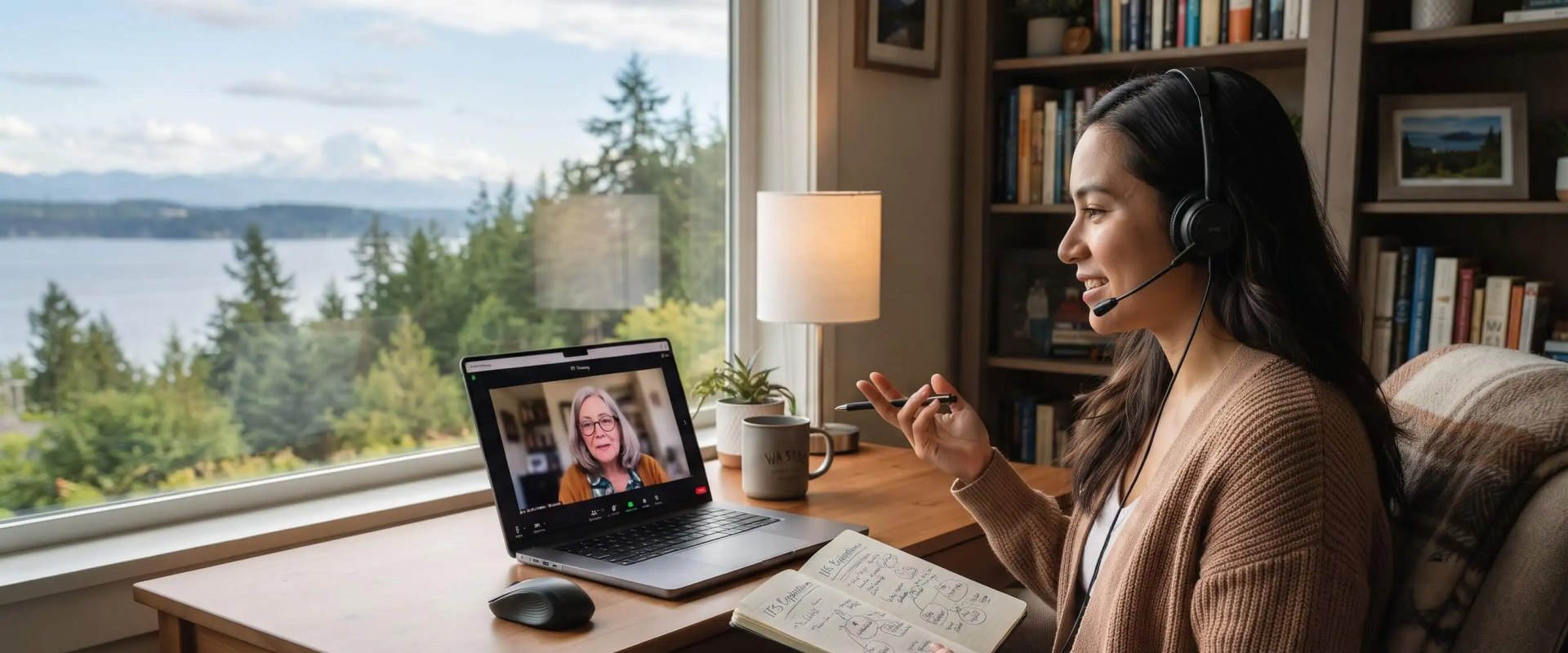
The harder part tends to come earlier, at the search bar, typing the question and deleting it twice. If you live in Spokane, or Everett, or a town off Highway 2 where the nearest IFS-trained therapist is three hours away, you probably want to know what happens on an ordinary Tuesday once you book.
Online IFS is a form of talk therapy done over a secure video call with a therapist licensed in Washington. The one firm rule is that you're in the state when you meet, and the rest comes down to a handful of small steps.
TL;DR Quick Answers
Online IFS Therapy in Washington · Telehealth
Online IFS therapy in Washington is Internal Family Systems therapy over secure video with a therapist authorized to practice in the state. You need to be physically in Washington for each session, and the room around you matters far less than most people expect.
Who it's for: Adults anywhere in the state, including rural counties with no IFS-trained therapist nearby.
What you need: A device with a camera, a steady connection, headphones, and a door that closes. A parked car works too.
How sessions run: About 50 minutes on a HIPAA-compliant video platform, usually weekly, at a pace you set.
Coverage: State-regulated plans pay for telehealth at the same rate as in-person care under RCW 48.43.735.
Does it work: A 2022 meta-analysis of randomized trials found video therapy roughly as effective as office visits.
First step: A free 15-minute call to check fit before anything formal begins.
Top Takeaways
Where you sit sets the rules. You need to be in Washington for each session, and your therapist needs to be authorized to practice here.
Six manageable steps. Check the license, book a consultation, confirm coverage, set up your space, show up, and keep going.
Coverage matches in-person care. State-regulated plans pay for telehealth at the same rate as office visits.
IFS travels well over video. Work that faces inward depends less on the room than most people expect.
You set the pace. Nothing gets opened before you're ready, online or off.
What Online IFS Therapy In Washington Actually Is
Online IFS therapy in Washington is Internal Family Systems therapy over video, with a clinician licensed by the state. The method doesn't change when it moves online, though the room does.
You already talk in parts. Part of me wants to call. Part of me would rather wait. IFS takes that seriously, gets curious about what each part has been guarding, and makes room for the steadier Self underneath. This site's piece on the risks and benefits of IFS therapy goes further into the model and where its research stands.
For a clinician's view of how sessions run, Spokane therapist Lauren Rath walks through what you'll need and how to begin on her page about online IFS therapy in Washington.
This work tends to suit adults who look fine from the outside and feel otherwise inside. If you're in crisis right now, or a clinician has diagnosed you with a psychotic or dissociative disorder, ask them about other options before you start.
How Online IFS Therapy Works, Step By Step
Most people move through six steps, and none of them asks much of you at once.
Step 1: Confirm The Therapist Is Licensed In Washington
Washington's rules follow where you're sitting, so any therapist you see by telehealth has to be authorized to practice here. For nearly everyone, that means a Washington license. You can look one up on the Department of Health's provider credential search in about a minute. While you're there, ask the therapist about IFS training, because someone who took an online course is IFS-informed, while an IFS-trained therapist has finished at least Level 1 with the IFS Institute.
Step 2: Book A Free Consultation Call
Most IFS therapists offer a short free call, often 15 minutes, before anything formal begins. It's two people checking for fit. Ask how they pace the work, what they do when a part of you says no, and what happens if the connection drops. Nobody expects polished answers from you.
Step 3: Check Coverage And Costs
Washington's payment parity law, RCW 48.43.735, requires state-regulated health plans to pay for covered telehealth at the same rate as an in-person visit. Self-funded employer plans can follow different rules. Call your insurer and ask about telehealth mental health benefits by name. If you pay out of pocket, federal law entitles you to a written Good Faith Estimate before your first session.
Step 4: Set Up Your Telehealth Space
You'll want a phone or laptop with a camera, a connection that mostly holds, and somewhere you won't be overheard. Headphones help. Washington law treats your home as a valid place to receive care, and a parked car works for more people than you'd guess. When it's time, you click the secure link your therapist sends for their HIPAA-compliant video platform.
Step 5: Your First Online IFS Session
The first session usually runs about 50 minutes, and you'll spend most of it getting acquainted. Your therapist will ask what brought you in and what you're hoping for. Answer clumsily if that's how it comes out. A part or two might show up, maybe the one that worries or the one that never lets you rest, but nobody pries anything open.
Step 6: Ongoing Sessions And Parts Work
From there, sessions usually settle into a weekly rhythm. You and your therapist get to know whichever parts show up, one at a time, at the pace your system allows. Some days you'll keep the camera off. Other days you'll sit quietly for a full minute before anything comes, and that minute counts as much as the talking does.
Does IFS Work As Well Over Telehealth?
For most adults, the screen gets in the way far less than they expect. IFS asks you to turn inward and notice what's there, so the room around you carries less weight than people tend to assume. Plenty of people settle faster in their own chair, under their own blanket, than they ever did in a waiting room.
Online isn't right for everyone, though. If home isn't private or safe, or a screen keeps pulling your attention away, in-person care may suit you better, and a good therapist will tell you so.
The Washington Rules That Shape Online Therapy
You have to be physically in Washington during each session, so a weekend in Coeur d'Alene usually means rescheduling. Your therapist has to be authorized to practice here, wherever in the state they happen to live. State-regulated plans also pay for telehealth at the same rate as office visits, which keeps costs from nudging you back toward a waiting room.
For someone in Okanogan County or out on the Palouse, those rules decide whether an IFS-trained therapist is within reach at all.
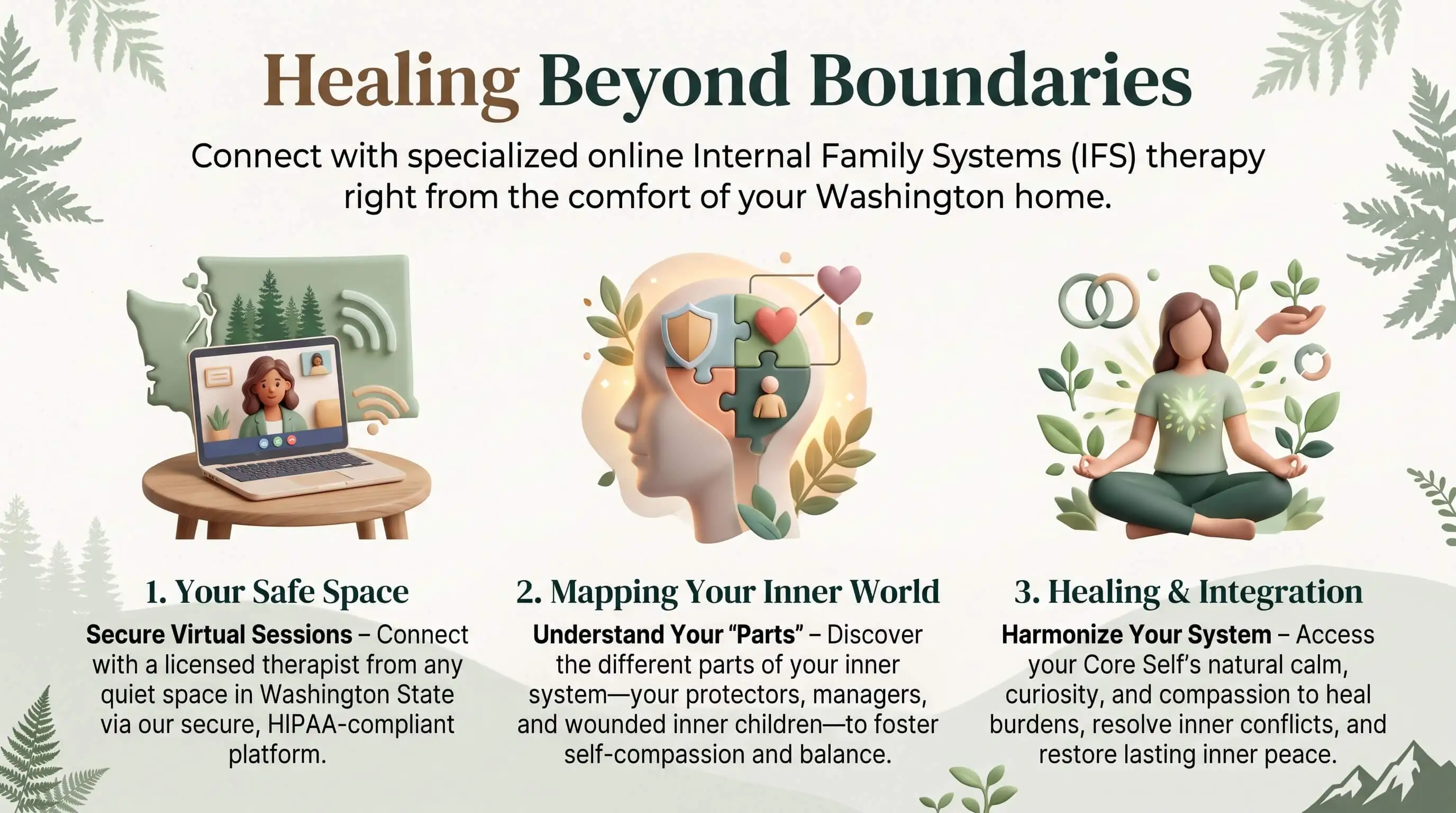
"The first few minutes of a video session tell me a lot. Someone pulls a blanket over their knees, or tilts the laptop so the window sits behind them, and I can watch a protective part deciding whether this is safe. I'd never see that in an office. I used to think of the screen as a barrier. Now it looks more like a door the client gets to hold, and once a part knows it can close that door, it usually lets me a little further in."
Essential Resources
Where I'd point you next, if you're still deciding. Three cover the law, two cover the model and its research, one covers the tech, and the last is for hard nights.
1. See What Washington Expects Of A Telehealth Provider
The Department of Health spells out when a practitioner may treat someone in Washington by telehealth, along with the training clinicians must finish before they offer it. Read it if you want to know what your therapist has signed up for.
Source: Washington State Department of Health: Telehealth Resources
2. Read Washington's Telehealth Rules In Plain English
The Center for Connected Health Policy keeps a running summary of the state's telehealth laws, including payment parity and the rule that your home counts as a valid place to receive care. I haven't found a clearer translation of the statutes.
Source: CCHP: Washington State Telehealth Laws
3. Go Straight To The Statute On Coverage
If your insurer pushes back on a telehealth claim, this is the law behind your question. It sets out when state-regulated plans have to cover telemedicine and how much they have to pay for it.
Source: RCW 48.43.735: Reimbursement For Telemedicine
4. Get Comfortable With The Technology First
The Northwest Regional Telehealth Resource Center serves Washington and its neighbors with patient resources and a connection speed test. Ten minutes there can spare you a frustrating first session.
Source: Northwest Regional Telehealth Resource Center
5. Hear From The People Who Train IFS Therapists
The IFS Institute describes the model in its own words and admits its research base is still small. I trust a training body more when it says that out loud.
Source: IFS Institute: What Is Internal Family Systems?
6. Weigh The Research On Connecting Over Video
A lot of people worry they can't really bond with a therapist through a screen. This systematic review looked at exactly that, and at whether symptoms improve as much as they do in person.
Source: Working Alliance And Outcomes In Videoconferencing Psychotherapy
7. Know Who Picks Up When You Call 988 In Washington
Washington's 988 Lifeline runs through three in-state crisis centers, free and around the clock. If things feel urgent, start here rather than with any kind of therapy.
Source: Washington State Health Care Authority: 988 Suicide & Crisis Lifeline
Supporting Statistics
I keep these numbers close whenever someone asks whether therapy over video means settling for less.
1. Video Therapy Holds Up Against The Office
A 2022 meta-analysis of randomized trials in Telemedicine and e-Health compared video and in-person psychotherapy for depression and found the two roughly comparable, with an effect size difference of g = 0.04.
That's about as close to no difference as research gets.
None of the trials tested IFS specifically, so I read this as encouraging for parts work rather than settled.
Source: Teletherapy Versus In-Person Psychotherapy For Depression (PubMed)
2. More Than A Third Of Mental Health Visits Already Happen By Telehealth
KFF and Epic Research found that telehealth accounted for 36% of outpatient mental health and substance use visits between March and August 2021. Rural patients leaned on it even harder, at 55% of visits compared with 35% in urban areas.
Choosing a video puts you in a very large company.
That rural figure matters in a state where the drive to a specialist can eat half a day.
Source: KFF: Telehealth Has Played An Outsized Role Meeting Mental Health Needs
3. Most Of Washington Has Too Few Mental Health Providers
Washington's 2018 State Health Assessment reported that 35 of the state's 39 counties were federally designated Mental Health Professional Shortage Areas.
Thirty-five of thirty-nine.
In most of those counties, an IFS-trained therapist down the road is hard to come by.
Telehealth leaves the shortage in place, though it takes the drive out of the picture entirely.
Source: Washington State Health Assessment: Access To Behavioral Health Providers (PDF)
Research shows that video therapy can be as effective as in-person care, while telehealth helps address mental health provider shortages across Washington, making professional support more accessible to individuals and families, including those connected to independent schools.
Final Thoughts And Opinion
The hardest moment in online IFS therapy usually comes right before you click the link, when some part of you lists every reason this is a bad idea.
That part has its reasons, and it's doing a job it took on a long time ago. It just doesn't get the final vote.
A few things I've come to believe about doing this work by video:
Convenience is clinical. When therapy costs a two-hour round trip, the part that wanted to cancel wins more often. Take away the drive and you take away its easiest excuse.
People arrive less armored at home. The cat walks across the keyboard, the coffee goes cold, and somehow that ordinariness helps.
Training matters more than the platform. A careful, well-trained therapist on a laptop will do better work than a rushed one in a beautiful office, so ask about training before you ask about Zoom.
Going slowly still keeps people safe. Video never makes it acceptable to hurry someone's system.
Here's an opinion I'll stand behind. We've treated online therapy as the backup plan for too long, as though it's what you settle for when the real thing isn't nearby. For a lot of people in this state, online IFS therapy in Washington · telehealth offers a way forward when video is the only version that was ever going to happen, and it works.
Frequently Asked Questions
Q: How Does Online IFS Therapy Work In Washington?
A: You meet over a secure video link with a therapist authorized to practice in Washington, while you're physically in the state. Sessions follow the same IFS process an office would use. You get to know your parts one at a time, at whatever pace your system allows.
Q: Do I Have To Be In Washington For Every Session?
A: Yes, if your therapist holds only a Washington license. Once you cross the state line, that state's rules decide whether a session can happen, so most people just reschedule while they travel.
Q: Is Online IFS As Effective As In-Person?
A: Research on video therapy in general finds outcomes roughly comparable to in-person care. IFS-specific comparisons are still thin. Because IFS turns your attention inward, many therapists and clients find it moves to a screen with little loss.
Q: Does Insurance Cover Telehealth Therapy In Washington?
A: Washington's payment parity law requires state-regulated health plans to cover telehealth services they'd cover in person, and to pay the same rate. Self-funded employer plans can differ, so call your insurer and ask about telehealth mental health benefits specifically.
Q: What Platform Will We Use, And Is It Private?
A: Your therapist should use a HIPAA-compliant video platform and send you a secure link. Most of the time you won't need to install anything. If you want to know the exact platform, ask before your first session.
Q: What If I Don't Have A Private Room?
A: A parked car can work. So can a closed bedroom door with headphones, or a quiet corner at a friend's place. Tell your therapist if you're worried about being overheard, and the two of you can switch to quieter voices or typed answers.
Q: How Do I Check A Therapist's IFS Training?
A: Ask which level of IFS Institute training they've completed. "IFS-informed" usually points to introductory courses, while "IFS-trained" means at least Level 1. Then confirm their Washington license through the Department of Health.
Q: How Long Does Online IFS Therapy Take?
A: It varies a lot. Some people notice a shift within a few months of weekly sessions, and deeper trauma work takes longer. A good therapist will talk openly with you about pace and won't promise you a timeline.
Take The First Step
You don't need it figured out first. You don't even need to be sure IFS fits you. If one part of you is curious and another is already arguing you out of it, you're in a perfectly ordinary place to begin.
Lauren Rath Therapy offers a free 15-minute call for adults anywhere in Washington. Bring your questions, skeptical ones included, and see how it feels to talk it through.